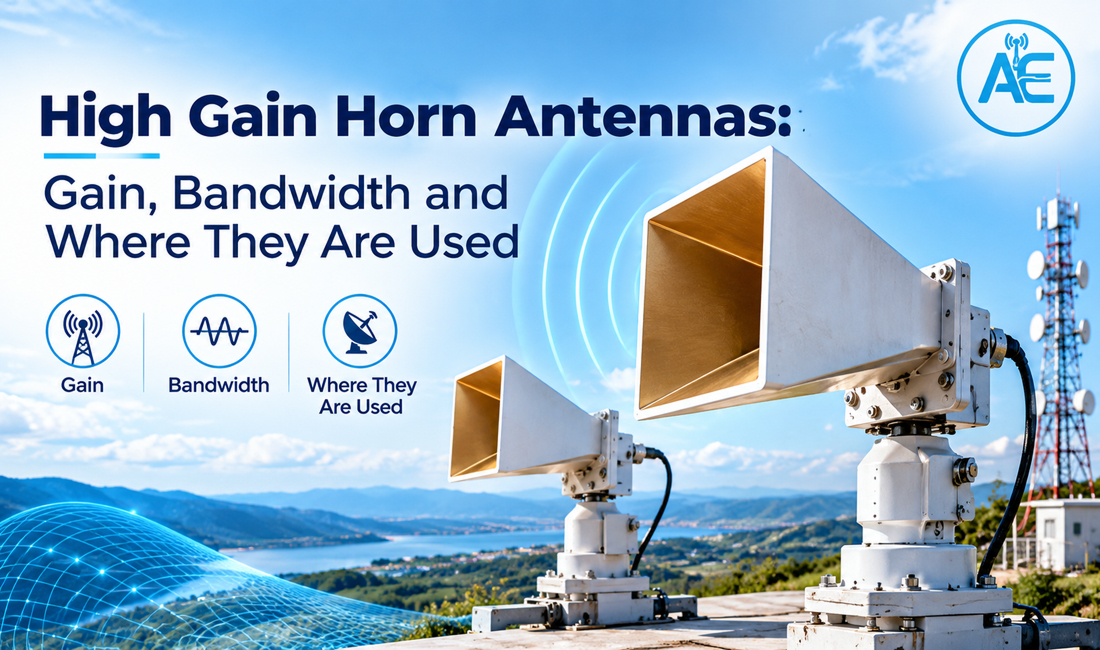
High Gain Horn Antennas: Gain, Bandwidth and Where They Are Used
A horn antenna is a flared waveguide and that plain shape explains why labs rely on it. Gain determines how tightly it focuses energy. Bandwidth determines how much spectrum one unit covers. The intended application determines the gain and bandwidth you need. Weigh them separately and you will buy the wrong unit.When buyers look for a high gain horn antenna manufacturer in India, usually the band and test method have already been decided. This article is about matching gain and bandwidth to that task and knowing what to ask a supplier before asking for a datasheet.
How the Flare Sets Gain and Beamwidth
It means the energy travelling down a waveguide hits the flare and gradually spreads out. Instead of spilling out, the energy arrives at the opening with controlled phase. The flare helps the horn antenna direct energy from the waveguide into free space.
Gain follows aperture area (in wavelengths). At the same frequency, doubling both aperture dimensions can increase directivity by about 6 dB, assuming similar aperture efficiency. The trade-off is that higher gain requires more careful alignment. The beam narrows in step. Actual gain also depends on aperture efficiency and two horns of similar size don't automatically mean they'll match, because phase error across the opening, the flare shape and the feed transition all play a part.
Bench results can drift for reasons unrelated to the antenna. Make sure you are in the far field. A rough rule is that you should be more than 2D²/λ from the pattern where D is the maximum dimension of the aperture. Keep the boresight aligned and don't have metal objects and mounting hardware that will ripple the pattern.
Standard Gain vs Broadband Horns
Standard gain horns have a well-controlled geometry so that their gain can be predicted and duplicated. This is why they are used as reference antennas in gain transfer and substitution measurements. The catch is bandwidth. They generally track a single waveguide band, so to cover several bands requires several horns.
Broadband horns, often ridged, cover a much wider range with one antenna, saving time on swept tests. But their gain isn’t flat. Usually, it increases with frequency. The pattern can become distorted at the top of the band. Another cost is size, as a wide band with a low end will need a large opening.
Both types are just as common. For a narrow band and tight uncertainty budget, a calibrated reference horn makes sense. A broadband RF horn antenna with calibration data over its frequencies is normally the practical choice for immunity sweeps or a device characterised over several octaves.
Test, Radar and EMC Uses
In measurements of components and antennas, the reference is usually a horn. You feed it. Point it at the device under test. Read the difference.
Radar teams have two ways of using horns. A horn illuminates a target or feeds a reflector inside a system. So power handling and environment matter most. In a test range it acts as a source or receiver so pattern cleanliness and known behaviour are most important. Another way to get directional gain is with a reflector such as a Grid Parabolic Antenna, but it is not a horn and works differently.
In EMC testing, the antenna's role depends on whether you are measuring emissions or testing immunity. A microwave horn antenna can be used for radiated emissions or immunity testing at higher frequencies, but only where the test method permits. Check the test method first. It will help you confirm whether a horn antenna is suitable.
Before you request a model, check these:
• Frequency range: must cover every test frequency with margin at band edges where gain and match degrade.
• Gain and beamwidth: they define your link budget and how precise you need to be.
• Polarisation: If you turn a linear horn away from the device it will lose signal, so check what your set up requires.
• Connector and mounting: You need an adapter when the interface is not a good match, which adds loss and uncertainty.
• Calibration needs: See if you can use typical values or if you need data on the specific unit.
• Datasheet: the published specs are your basis for comparison, so look for the conditions they were stated under.
Why Choose Antenna Experts
Antenna Experts is a trusted antenna manufacturer and supplier in India. We design and supply to defence, armed forces and commercial OEM buyers. If you're shortlisting a [url=https://www.antennaexperts.com/category/high-gain-horn-antenna]high gain horn antenna manufacturer in India[/url], the useful question is whether the maker can match a unit to your band and test method. Our High Gain Horn Antenna category is the place to begin.
Before you ask about a model, write down four things: the operating band, the gain and beamwidth you need, the connector or flange and what the antenna will do, whether that’s reference measurement, radar or EMC. With those answers we can send you a datasheet that suits your requirement rather than a general catalogue.
If your band is below where a horn is practical then our Military Log Periodic Dipole Antenna range may be better suited to it.
Conclusion
Choose a horn based on its frequency range, gain and beamwidth, your measurement conditions and how you plan to use it.
Ask Antenna Experts for horn antenna datasheets. 2026-10-30 19:19 Best 8 Property Management CRM Development Companies in Indianapolis Are Black Hydrocolloid Patches a Practical Choice for Spot Care? Nainital tour package from Delhi Steps In Buying Reliable Car Parts Security Camera Installation in Toronto for Smarter Surveillance Outsourced Call Center Solutions for Efficient Business Communication Gabon eVisa United Airlines DFW Terminal +1-855-742-0149 Choosing a Gynecomastia Surgery Clinic: The Questions Men Often Overlook Corporate Gifts for Employees – Promo Gifts Which Swimming Pool Heating System Is Most Energy-Efficient? Alarm Installation in Mississauga for Complete Property Security KLM Airlines Atlanta Office