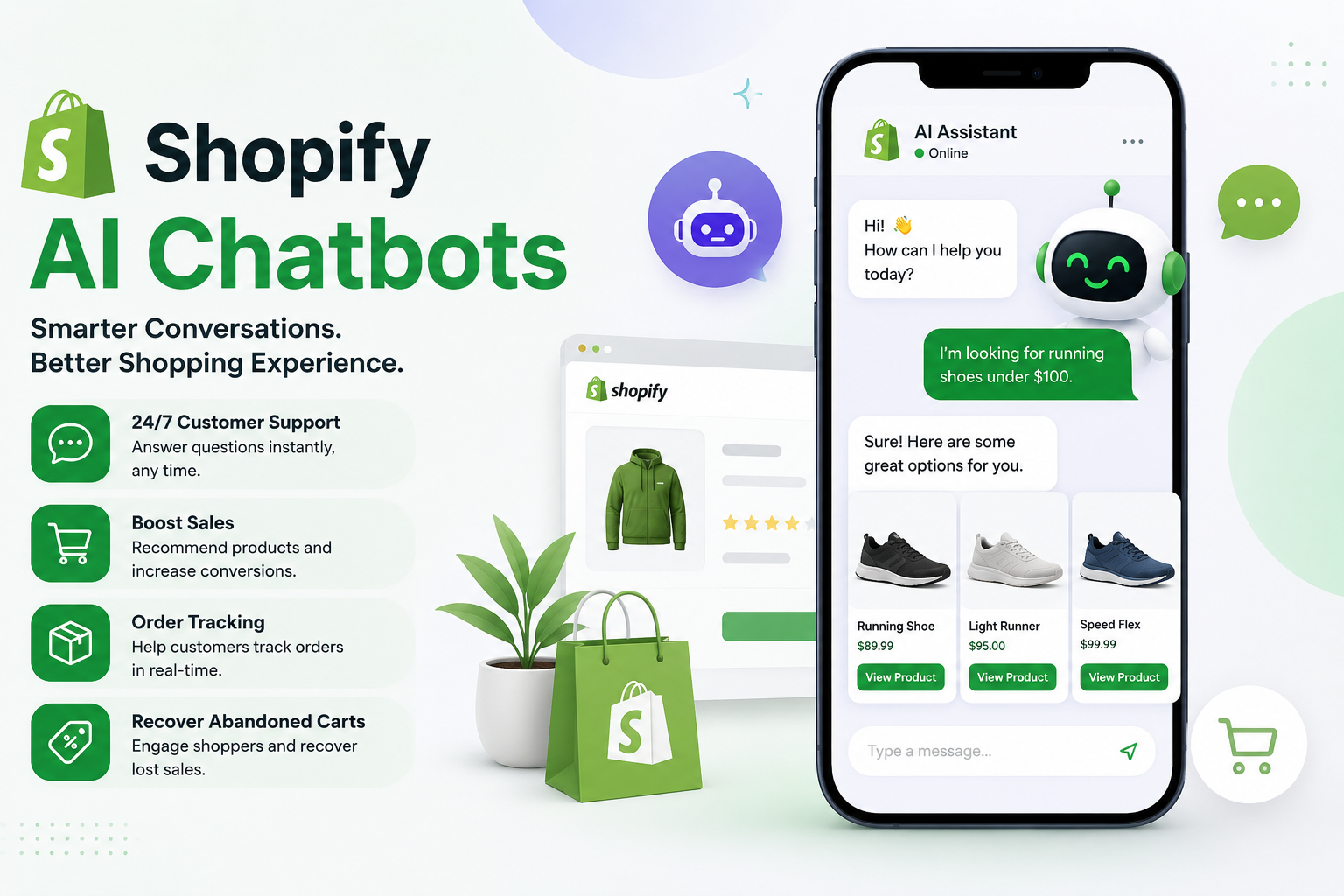
How AI Chatbots Can Shorten the Shopify Customer Buying Journey
IntroductionA long buying journey can cost Shopify stores valuable sales. Customers may arrive with purchase intent but leave after struggling to find the right product, compare options, understand shipping, or get answers to simple questions. This is where Shopify AI chatbots can make a meaningful difference.
Instead of making shoppers navigate through multiple pages before reaching a decision, AI chatbots can guide them through product discovery, recommendations, questions, cart management, and purchase decisions in one conversational experience.
For Shopify beginners, small ecommerce businesses, influencers, and growing online brands, the goal isn't simply to add another support channel. It's to remove unnecessary steps between "I'm looking for something" and "I'm ready to buy."
Shopify itself describes product recommendations as a way to help shoppers discover products and increase online store sales. Its recommendation system can use related and complementary products to support discovery throughout the customer journey.
What Is the Shopify Customer Buying Journey?
The customer buying journey is the series of steps a shopper takes before completing a purchase.
A typical ecommerce journey looks like this:
Discover the store
Search for a product
Browse product pages
Compare options
Evaluate price and features
Check shipping and return policies
Choose a product or variant
Add the product to the cart
Complete checkout
Receive post-purchase support
The problem is that customers don't always move through these stages smoothly.
A shopper may jump between product pages, search engines, reviews, FAQs, and support channels before making a decision.
AI chatbots can bring many of these interactions into a single conversation.
Why a Shorter Buying Journey Matters
Every additional step creates another opportunity for a customer to lose interest.
Imagine a shopper looking for a pair of running shoes. They might normally:
Search the category
Open multiple products
Read specifications
Check the size guide
Compare prices
Search for reviews
Look for shipping information
Return to the product page
Add an item to the cart
A chatbot can reduce this process by asking what the customer needs and narrowing the options.
For example:
Customer: "I need running shoes for daily 5K runs under $100."
Chatbot: "Do you prefer maximum cushioning or a lightweight feel?"
Customer: "Lightweight."
Chatbot: "Based on your budget and preference, here are three suitable options."
The customer moves from a broad search to a focused shortlist much faster.
1. Speed Up Product Discovery
Product discovery is often the first major bottleneck.
Large Shopify stores may have hundreds or thousands of products. Customers don't necessarily want to browse every category.
AI chatbots allow shoppers to use natural language instead.
Instead of searching for:
"Women's running shoes size 7"
a customer could say:
"I need comfortable women's running shoes for long walks."
The chatbot can understand the intent and recommend relevant products.
This conversational approach can reduce the amount of manual searching customers need to do.
2. Ask Questions That Narrow the Choices
An effective chatbot doesn't immediately show dozens of products.
It asks questions that help identify the customer's requirements.
For example, a fashion chatbot might ask:
What occasion are you shopping for?
What's your preferred size?
What's your budget?
Do you have a preferred color?
What style do you prefer?
A skincare store could ask about:
Skin type
Primary concern
Product preferences
Budget
Existing routine
These questions work like a salesperson narrowing down options in a physical store.
3. Give Personalized Product Recommendations
Once the chatbot understands customer intent, it can recommend relevant products.
Shopify notes that recommendation strategies can be tailored to different points in the customer journey, including related and complementary products.
For example, suppose a customer says:
"I need a laptop for college under $800."
Instead of showing every laptop under $800, the chatbot could prioritize models based on:
Portability
Battery life
Storage
Performance
Customer requirements
The customer gets a smaller, more relevant selection.
4. Reduce Product Comparison Time
Customers often visit multiple product pages because they want to compare similar products.
An AI chatbot can summarize those differences conversationally.
For example:
"What's the difference between Product A and Product B?"
The chatbot could explain:
Feature Product A Product B
Price Lower Higher
Battery 8 hours 12 hours
Storage 128 GB 256 GB
Best for Basic use Heavy use
It can then explain which product better matches the customer's stated needs.
This reduces the need to manually compare multiple pages.
5. Answer Questions at the Moment of Decision
Timing matters.
A customer who asks a question while considering a product is often closer to purchase than someone casually browsing.
Questions might include:
Is this waterproof?
Does this fit a 15-inch laptop?
Is the material breathable?
What's the return period?
How long does delivery take?
Is this available in blue?
AI chatbots can provide answers immediately when trained on accurate store information.
Some Shopify chatbot solutions are designed to use product catalogs, FAQs, store pages, and other business information to answer these types of questions.
6. Reduce Purchase Uncertainty
Customers may want a product but still hesitate because they aren't completely confident.
For example:
"I'm not sure whether this camera is suitable for beginners."
A chatbot can explain the relevant features and help the customer determine whether the product matches their requirements.
This is important because ecommerce removes many of the reassuring interactions available in physical stores.
A chatbot can provide some of that guidance digitally.
7. Make Size and Variant Selection Easier
Variant selection can slow down the buying process, especially for fashion and footwear stores.
Customers may hesitate over:
Size
Color
Fit
Material
Capacity
Storage
Model
An AI chatbot can ask targeted questions and direct customers toward the appropriate variant.
For example:
"What size do you normally wear?"
"What fit do you prefer?"
"Would you like black, navy, or beige?"
The customer doesn't have to figure everything out alone.
8. Handle Shipping and Return Questions Quickly
Shipping and returns can become major purchase barriers.
Customers may ask:
"How much is shipping?"
"Can I return this if it doesn't fit?"
"How long will delivery take?"
Instead of searching through the footer or FAQ section, shoppers can ask the chatbot directly.
This keeps them engaged with the buying journey instead of sending them away from the product page.
9. Cross-Sell Without Adding Extra Browsing
Once a customer chooses a product, the chatbot can suggest relevant complementary products.
For example:
A customer purchases a camera.
The chatbot might recommend:
Memory card
Camera bag
Extra battery
Shopify recommends using relevant complementary products to help customers discover additional products and potentially increase sales.
The advantage of conversational cross-selling is that the customer doesn't have to search for those products separately.
10. Move Customers From Chat to Cart Faster
The fewer unnecessary actions a customer has to take, the smoother the buying experience can become.
Some AI shopping assistants support product discovery, recommendations, product comparisons, and adding products to the cart through conversation.
For example:
Customer: "I like the second option."
Chatbot: "Great choice. Would you like me to add the medium size in black to your cart?"
This creates a direct bridge between product discovery and cart creation.
11. Reduce Cart Abandonment
A shorter buying journey can also help address cart abandonment.
Customers may abandon carts because they still have unanswered questions.
For example:
"Is shipping free?"
"Can I change the size later?"
"When will my order arrive?"
"What's the return policy?"
An AI chatbot can address these concerns before the customer leaves.
Some Shopify chatbot applications specifically offer cart recovery features alongside product recommendations and customer support.
12. Support Customers During Checkout
Checkout is where purchase intent is highest.
A chatbot can help customers with questions about:
Payment options
Shipping
Discounts
Order details
Delivery times
Returns
The chatbot shouldn't interfere unnecessarily with the checkout process. Instead, it should be available when customers need clarification.
The objective is simple: remove friction without creating another distraction.
13. Create a More Connected Shopping Experience
Without AI, the customer journey can feel fragmented.
A shopper might:
Search → Product page → FAQ → Search again → Support → Product page → Cart
With a well-designed AI chatbot, the journey can become:
Search → Conversation → Recommendation → Question → Cart
This doesn't mean every customer should follow exactly the same path. AI allows the journey to adapt based on what each shopper needs.
Shopify's own recent work on generative recommendations also emphasizes that buyer journeys are sequences of interactions—searches, views, favorites, add-to-carts, and purchases—rather than isolated clicks.
How to Build a Shorter Buying Journey With AI
Start With Your Biggest Friction Point
Don't automate everything at once.
Identify where customers are dropping off.
For example:
Product discovery problem → Build an AI product finder
Product comparison problem → Add comparison assistance
High support volume → Automate FAQs
Cart abandonment → Create cart recovery conversations
Low average order value → Add relevant cross-selling
Connect the Chatbot to Reliable Store Data
Your chatbot should use accurate information about:
Products
Prices
Variants
Inventory
Shipping
Returns
FAQs
Incorrect information can make the buying journey worse rather than better.
Keep Conversations Short
Don't make customers complete a lengthy questionnaire.
Ask one relevant question at a time and adapt based on the answer.
Give Customers Human Support
AI should not become a barrier between customers and your team.
Provide an easy handoff when a shopper has a complex issue or needs human assistance.
How to Measure Whether the Journey Is Actually Shorter
Don't assume that adding a chatbot automatically improves conversions.
Measure its impact.
Important metrics include:
Time to product discovery
Chat engagement rate
Product recommendation clicks
Add-to-cart rate
Conversion rate
Average order value
Cart abandonment rate
Chat-assisted revenue
Customer satisfaction
You can compare these metrics before and after implementation or compare chatbot-assisted shoppers with visitors who don't use the chatbot.
Conclusion
A long and complicated buying journey can create unnecessary friction for Shopify customers. Shoppers may leave because they can't find the right product, don't understand the differences between options, or can't get answers to important questions quickly.
AI chatbots can shorten that journey by bringing product discovery, recommendations, comparisons, support, cart assistance, and purchase guidance into one conversational experience.
The best strategy isn't to make the chatbot talk to every visitor constantly. It's to make it available at the moments when customers need help most.
Start with one high-friction stage, connect your chatbot to accurate store data, create concise conversational flows, and measure the impact on conversions and cart behavior. Over time, use real customer conversations to improve your recommendations and responses.
When implemented thoughtfully, an AI chatbot can turn a multi-step shopping process into a faster, more personalized path from product discovery to purchase.
Frequently Asked Questions
1. How can AI chatbots shorten the Shopify buying journey?
AI chatbots can reduce unnecessary browsing by helping customers discover products, compare options, answer questions, select variants, and move toward the cart through a single conversation.
2. Can AI chatbots help increase Shopify conversions?
They can create more conversion opportunities by reducing purchase friction, providing personalized recommendations, and answering customer questions at important decision points.
3. Can an AI chatbot help customers choose the right product?
Yes. It can ask about factors such as budget, intended use, preferences, size, and features before recommending relevant products.
4. Can AI chatbots reduce cart abandonment?
They can help address common reasons for abandonment, such as unanswered questions about shipping, returns, product details, and payment.
5. What should Shopify stores measure after implementing an AI chatbot?
Track chat engagement, product recommendation clicks, add-to-cart rate, conversion rate, average order value, cart abandonment, customer satisfaction, and chatbot-assisted revenue. 2026-8-14 18:40 Airlink Airlines Harare Office +1-888-738-0817 Forest Green Farms CBD Gummies: Features, Usage & Customer Reviews SodaBurn Drops: Pros and Cons, Ingredients, Benefits, and Complete Review QuickBooks Pro Upgrade to Enterprise Without Losing Data Looking for Easy Everyday Outfit Options? SodaSlim Weight Loss The Biggest Child Custody Mistakes Parents Make and How to Avoid Them Qatar Airways London Office +1-888-738-0817 https://www.facebook.com/JellyBlue.Get/ JellyFil Supplement How Much Does a Photographer Lifestyle Montreal Cost in 2026? Kitchen Renovation Houston: How to Create a Kitchen That Works for Your Home D Wall Construction, Diaphragm Wall Grabs, Diaphragm Wall Grab Machine