Choose Dissolved Air Flotation or Sedimentation by Density
Choose dissolved air flotation when your particles are light or slow to settle, such as algae, grease and fine floc, and choose sedimentation when they are dense and the sludge must be thick. Loading rates favor flotation, while some sludge tests favor settling. Run a jar test on both before you pick.
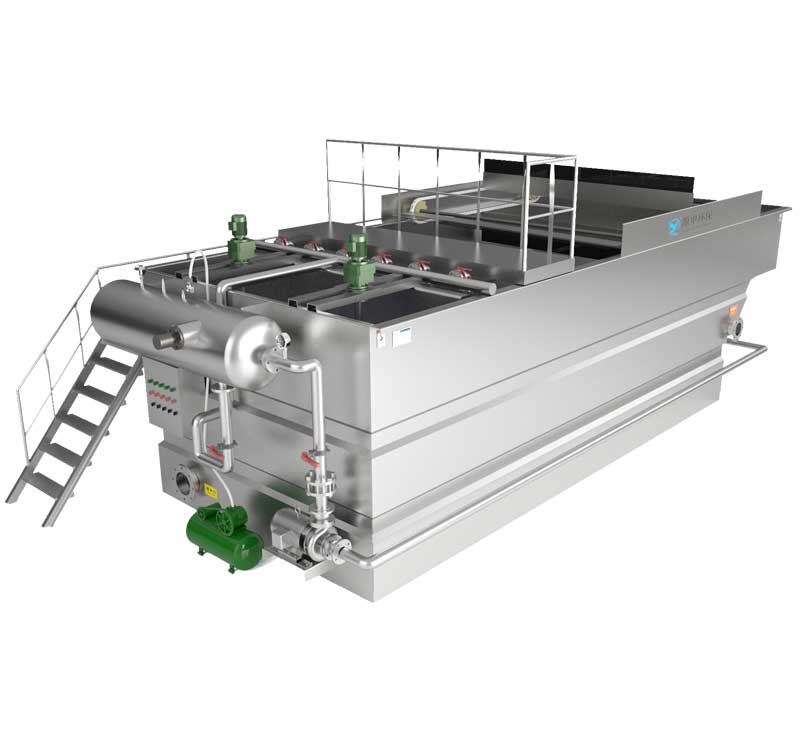
Reject Sedimentation for Algae and Other Light Solids
Sedimentation relies on weight, and algae carry very little. WaterWorld’s review of high-rate clarifiers says flotation suits light particles such as algae. Its conditions are water under 100 NTU, preferably under 30, with low alkalinity and high color. Check the source before the equipment.
I’d rule out a settling basin for any source whose main load floats or hangs in suspension. I’d keep it for dense grit and heavy metal floc, which sink without help.
Prefer Dissolved Air Flotation When Footprint Is Tight
WaterWorld lists common surface loading rates of 4 to 8 gpm/ft² for flotation against about 1 for a conventional settling basin. In metric terms that is 9.8 to 19.6 meters per hour against 2.4. A plant treating 100 m³/h would need about 41 square meters of settling area but only 5 to 10 square meters of flotation area.
Those figures come from drinking water, where the target particles are light. Industrial wastewater with heavier solids may not reach the same rates, so treat them as a ceiling from one use rather than a promise for yours.
Weigh the Sludge as Carefully as the Water
Leopold, a flotation supplier, reports float solids of 3 to 5 percent against 0.5 to 1.0 percent for conventional clarifier sludge. A Brazilian study of water treatment residue points the other way, with sedimentation thickening reaching 7.10 percent solids. Flotation still produced cleaner clarified water, 23.3 NTU against 46.3.
Before you compare dissolved air flotation with settling, decide whether you are comparing clarifier sludge or thickened residue, because the winners differ. A supplier’s brochure and a peer-reviewed thickening test answer different questions.
Compare Chemical Claims With Your Own Jar Tests
Suppliers say flotation needs lower chemical doses than sedimentation, and a High Rate DAF brochure adds that polymer is typically not required ahead of membranes. Both are vendor claims about favorable water. I’d accept them only after a jar test shows the same dose on your sample.
Chemistry also reaches the sludge side, because a coagulant that clears the water can leave a wetter float. Record the dose and the float volume in the same row of your notes, so a cheap dose does not hide an expensive sludge.
Use Flotation When Flows Start and Stop
A flotation tank reaches steady quality quickly. A patent from a flotation inventor credits the process with fast start-up and stable water soon after, and a high-rate supplier says its units start and stop within minutes. Batch food plants and washdown schedules create exactly that stop-and-go pattern.
A settling basin may need longer to settle into steady operation, so intermittent flows suit it less. I’d weigh start-up time as a real cost when the plant runs a single shift.
Price the Energy Flotation Adds
Flotation adds a recycle pump and an air compressor that a settling basin lacks. Wuxi Yosun’s model table lists a 15 kW reflux pump and a 2.2 kW compressor on its 100 m³/h unit. That is about 0.17 kW of installed power per cubic meter per hour before the skimmer and chemical tank.
Installed power overstates running power, but the order of magnitude explains a simple rule. On a stream that settles well, I’d not pay the power bill for dissolved air flotation.
Shorten Flocculation Only After a Pilot
High-rate flotation pilots at Newport News, Virginia, and Fairfield, Connecticut, tested flocculation times of 6 to 7 minutes and hydraulic loadings of 17 to 44 meters per hour, according to the research summary. Those are research values, not guarantees. I’d copy them into a pilot plan, never into a purchase order.
Jar tests rank the options cheaply, and most manufacturers rent pilot units to test loading, recycle, air-to-solids ratio and polymer, according to a water-treatment reference. If your water settles on its own, a lamella plate clarifier may cost less to run than a flotation tank.
Run Two Tests This Week
Take a sample from your worst day and run one settling test and one flotation test, recording turbidity and sludge volume for each. If flotation wins on water but loses on sludge, price the sludge before you buy dissolved air flotation equipment, and check Yosun’s DAF page for models from 2 to 200 m³/h.
Frequently Asked Questions
Q: When is dissolved air flotation better than sedimentation?
A: It wins when particles are light, such as algae, fine floc and grease, and the source is low in turbidity. Dense grit still belongs in a settling basin, so sort your solids before you shop.
Q: How much smaller is a flotation tank than a settling basin?
A: On WaterWorld’s drinking-water rates, flotation at 9.8 to 19.6 m/h needs roughly one fourth to one eighth of the area that settling at 2.4 m/h needs. Heavier industrial solids may not reach those rates, so use jar and pilot data.
Q: Does flotation make thicker sludge?
A: Often, but not always. Leopold reports 3 to 5 percent float solids, while a Brazilian thickening test reached 7.10 percent by sedimentation. Test your own residue.
Q: Can a lamella clarifier replace flotation?
A: If your solids settle on their own, a lamella plate clarifier avoids the recycle pump and compressor that flotation needs. If they float or hang in suspension, run the flotation test.