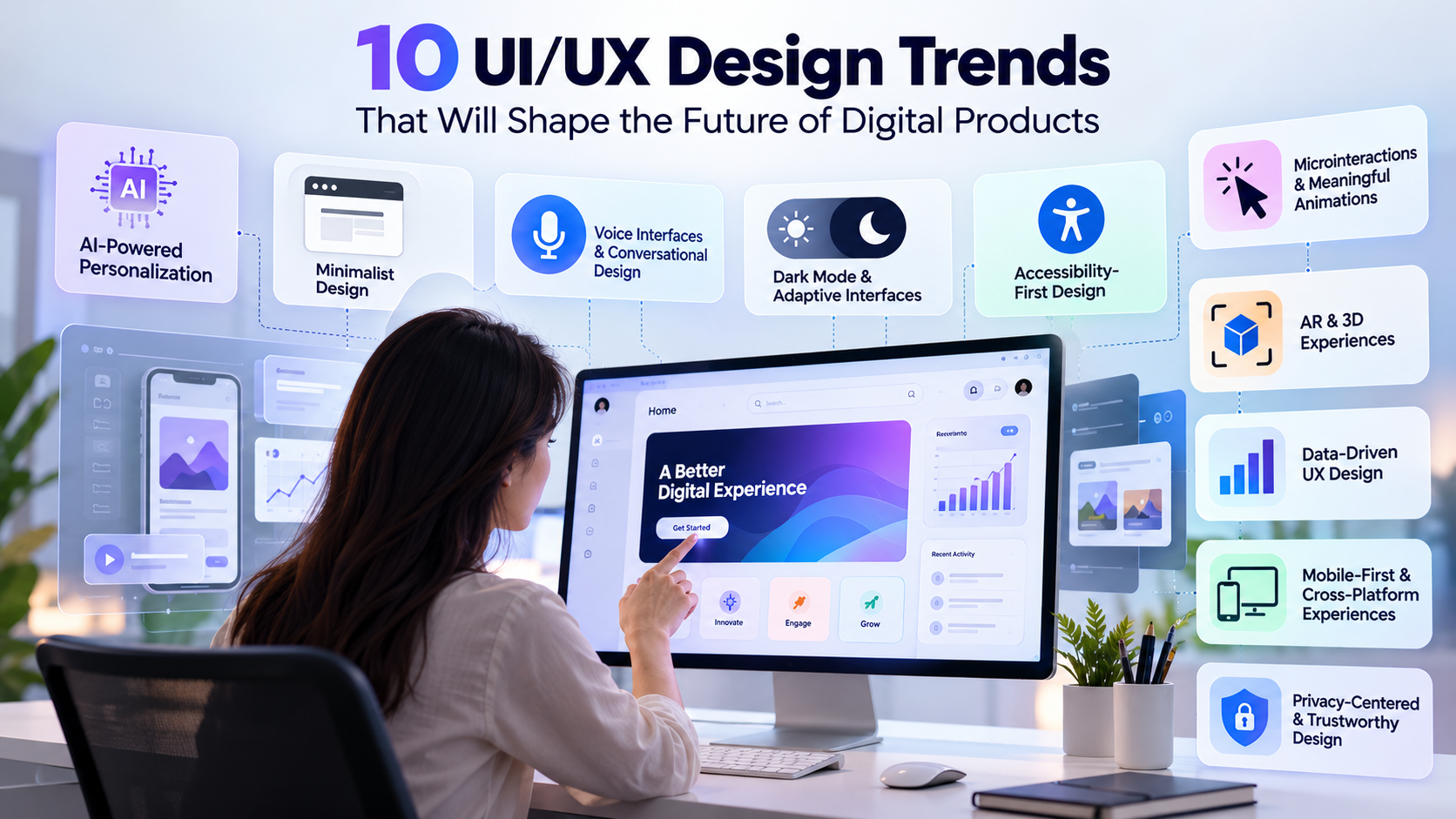
10 UI/UX Design Trends That Will Shape the Future of Digital Products
Digital products are evolving rapidly, and user expectations are changing along with them. People now expect websites, mobile applications, and software platforms to be intuitive, accessible, visually appealing, and easy to navigate. A well-designed digital product is no longer just about appearance; it is about creating meaningful experiences that help users accomplish their goals efficiently.User Interface (UI) and User Experience (UX) design play an essential role in meeting these expectations. As new technologies emerge and digital habits evolve, businesses must adapt their design strategies to remain competitive.
From artificial intelligence to personalized interfaces, several emerging trends are shaping the future of digital product design. Here are ten important UI/UX design trends that businesses and designers should watch.
1. AI-Powered Personalized User Experiences
Artificial intelligence is transforming how digital products interact with users. Instead of providing the same experience to everyone, modern platforms can use AI to understand individual preferences, behaviors, and needs.
For example, e-commerce platforms can recommend products based on browsing history, while streaming applications can suggest content according to viewing habits. Similarly, SaaS platforms can customize dashboards based on how individual users work.
AI-powered personalization makes digital experiences more relevant and efficient. However, designers must balance personalization with user privacy and transparency. Users should understand how their information is being used and have control over their preferences.
2. Minimalist and Functional Design
Minimalism continues to influence modern UI/UX design. Clean layouts, simple navigation, readable typography, and carefully selected visual elements help users focus on what matters most.
An overcrowded interface can confuse visitors and make it difficult to find important information. Minimalist design addresses this problem by removing unnecessary elements and prioritizing essential functionality.
However, minimalism does not mean removing everything from a page. Every design element should serve a purpose, whether it communicates information, supports navigation, or encourages user interaction.
Businesses that prioritize functional simplicity can create digital products that feel more organized and easier to use.
3. Voice User Interfaces and Conversational Design
Voice technology is creating new opportunities for users to interact with digital products. Voice assistants, smart devices, and conversational interfaces allow people to complete tasks without relying entirely on traditional buttons and menus.
Voice-enabled interfaces can be particularly useful for accessibility, hands-free interactions, and situations where typing is inconvenient.
Conversational design is also becoming increasingly important in customer support and digital services. Chatbots and AI assistants can guide users through processes, answer questions, and provide relevant recommendations.
Designers must ensure that these interactions feel natural, provide clear feedback, and offer alternative navigation methods when voice recognition fails.
4. Dark Mode and Adaptive Interfaces
Dark mode has become a popular interface option across mobile applications, websites, and desktop software. It provides an alternative visual experience by using darker backgrounds and lighter text.
Many users prefer dark mode because it offers a different appearance and can feel more comfortable in low-light environments. It can also help reduce power consumption on certain OLED displays.
Beyond dark mode, adaptive interfaces are becoming more common. These interfaces adjust their appearance according to user preferences, device settings, and environmental conditions.
Designers should maintain sufficient color contrast, readable typography, and consistent visual hierarchy across different interface modes.
5. Accessibility-First Design
Accessibility is becoming a fundamental part of modern digital product development. An accessible product ensures that people with different abilities can navigate and interact with digital interfaces effectively.
Designers are increasingly considering accessibility from the beginning rather than treating it as a final improvement.
Important accessibility practices include:
Providing alternative text for meaningful images.
Maintaining sufficient color contrast.
Supporting keyboard navigation.
Using clear labels for interactive elements.
Designing interfaces that work with screen readers.
Avoiding interactions that depend only on color or visual cues.
Accessibility benefits more than users with disabilities. It also improves usability for older adults, people using smaller screens, and individuals interacting with products in challenging environments.
6. Microinteractions and Meaningful Animations
Microinteractions are small interface responses that provide feedback when users perform specific actions. Examples include button animations, loading indicators, notification alerts, and subtle hover effects.
Although these interactions may seem minor, they can significantly improve the overall user experience.
For instance, a button changing its appearance after being clicked helps users understand that their action was successful. A progress indicator can reduce uncertainty during a lengthy process.
Modern UI/UX design increasingly focuses on purposeful animations rather than decorative movement. The goal is to guide users, communicate system status, and make interactions feel responsive without slowing down the experience.
7. Immersive Experiences with AR and 3D Elements
Augmented reality (AR) and three-dimensional design are creating new ways for users to explore digital products.
Retail businesses can use AR to let customers visualize furniture in their homes or preview products before purchasing. Educational platforms can use interactive 3D models to explain complex concepts, while other industries can create more engaging product demonstrations.
These technologies can make digital experiences more interactive and informative.
However, immersive design should always support a clear user objective. Heavy 3D elements and unnecessary visual effects can negatively affect loading speed and accessibility. Designers must consider performance and usability alongside visual innovation.
8. Data-Driven UX Design
Modern UX design increasingly relies on real user data instead of assumptions. Businesses can analyze user behavior, conduct usability tests, and collect feedback to understand how people interact with their digital products.
Useful research methods include:
Heatmaps to identify where users interact with a page.
A/B testing to compare different design variations.
Session recordings to understand navigation difficulties.
User surveys to collect direct feedback.
Analytics tools to identify conversion and engagement patterns.
Data-driven design helps businesses identify usability problems and make informed improvements.
However, quantitative data should be combined with qualitative research. Numbers can show what users are doing, while interviews and usability testing can help explain why they are doing it.
9. Mobile-First and Cross-Platform Experiences
Mobile devices remain an important part of everyday digital interactions. As a result, designers are prioritizing mobile-first strategies when creating websites, applications, and software products.
A mobile-first approach begins with the smallest screen and gradually expands the design for larger devices. This encourages teams to prioritize essential content, simple navigation, and efficient interactions.
At the same time, users expect consistent experiences across smartphones, tablets, laptops, and desktop computers.
Cross-platform design helps maintain familiar navigation patterns, visual consistency, and functionality across different devices. Responsive layouts, scalable components, and flexible design systems make this process easier.
10. Privacy-Centered and Trustworthy Design
As digital products collect increasing amounts of personal information, users are becoming more concerned about privacy and data security.
Trust is now an important part of the user experience. Businesses must communicate their data practices clearly and give users meaningful control over their information.
Privacy-centered design includes:
Clear and understandable privacy notices.
Transparent permission requests.
Simple cookie and tracking preferences.
Secure account management options.
Easy-to-understand data controls.
Avoiding misleading interface patterns.
Designers should also avoid dark patterns that manipulate users into taking actions they did not intend to take.
A transparent and trustworthy interface can strengthen customer relationships and improve long-term brand credibility.
How Businesses Can Prepare for the Future of UI/UX Design
Following every emerging trend is not necessarily the right strategy for every business. The best approach is to understand the needs of the target audience and select design improvements that solve real problems.
Businesses can prepare by investing in user research, regularly testing their digital products, and building flexible design systems. They should also monitor technological developments while maintaining accessibility, usability, and performance as core priorities.
Working with experienced professionals can help organizations make better design decisions. Businesses exploring potential design partners can use resources such as Global UX Agency to discover and evaluate UX design agencies that align with their project requirements.
Final Thoughts
The future of UI/UX design will be shaped by personalization, artificial intelligence, accessibility, immersive technologies, and privacy-focused experiences. These trends are changing how people interact with websites, applications, and other digital products.
However, successful design is not simply about adopting the latest technology or following popular visual styles. It is about understanding users, solving their problems, and creating experiences that are both functional and enjoyable.
Businesses that embrace thoughtful, user-centered design will be better positioned to build meaningful digital products, strengthen customer relationships, and remain competitive in an increasingly digital world.
This article explores ten important UI/UX design trends shaping the future of digital products, incl
Share:
