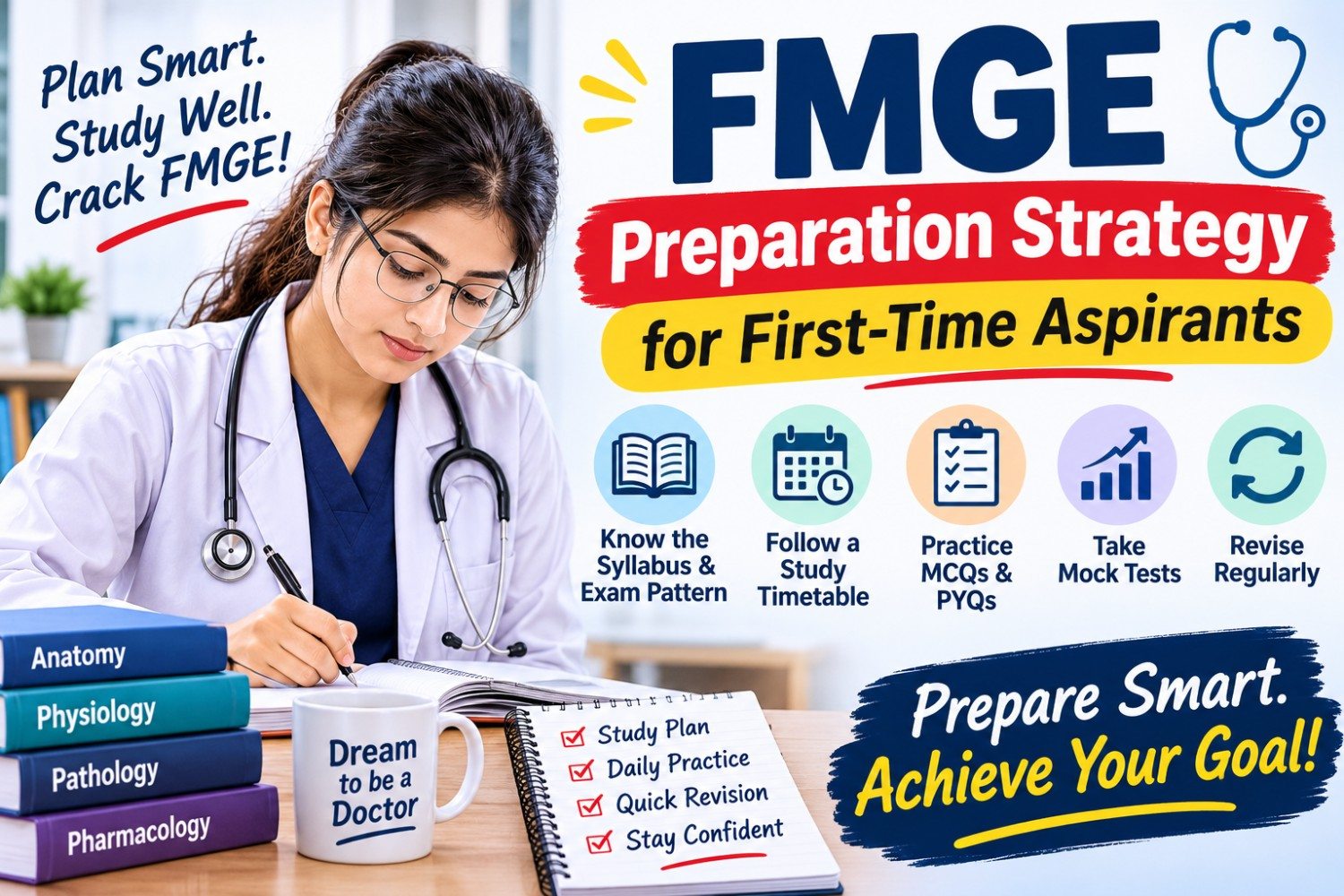
subject: FMGE Preparation Strategy for First-Time Aspirants [print this page]
The Foreign Medical Graduate Examination (FMGE) is an important screening test for Indian and overseas medical graduates who want to obtain medical registration in India. Preparing for FMGE for the first time can feel challenging because the examination covers multiple medical subjects and requires strong conceptual understanding, consistent revision and regular question practice.
A well-planned preparation strategy can help first-time aspirants cover the syllabus, improve accuracy and build confidence before the examination. Instead of studying randomly, candidates should follow a structured study plan that combines concept learning, MCQ practice, previous-year questions and regular revision.
Before starting your preparation, understand the examination pattern and syllabus. This will help you organise your study schedule and identify the subjects that require more attention.
FMGE is a computer-based examination consisting of:
Total questions: 300 MCQs
Total marks: 300
Examination mode: Computer-based test
Passing marks: 150 out of 300
Negative marking: No negative marking
The examination covers pre-clinical, para-clinical and clinical subjects. Understanding the pattern helps you plan your preparation according to the examination requirements.
Always refer to the latest official information bulletin released by the National Board of Examinations in Medical Sciences (NBEMS).
2. Start with a Subject-Wise Study Plan
One of the biggest mistakes first-time FMGE aspirants make is studying subjects without following a proper sequence. A subject-wise preparation strategy helps maintain consistency and improves understanding.
Divide your preparation into three major categories:
Pre-Clinical Subjects
Anatomy
Physiology
Biochemistry
Para-Clinical Subjects
Pathology
Pharmacology
Microbiology
Forensic Medicine
Community Medicine
Clinical Subjects
Medicine
Surgery
Obstetrics and Gynaecology
Paediatrics
Ophthalmology
ENT
Orthopaedics
Dermatology
Psychiatry
Anaesthesia
Radiology
Give additional revision time to subjects where your concepts are weak. Avoid spending too much time on a single subject at the expense of others.
3. Follow a Consistent Daily Study Timetable
A realistic timetable is more effective than an unrealistic schedule that is difficult to maintain.
Here is a sample daily study plan for FMGE first-time aspirants:
Time
Study Activity
7:00 AM – 9:00 AM
Study a major subject
9:00 AM – 9:30 AM
Short break
9:30 AM – 11:30 AM
Continue concept learning
11:30 AM – 12:30 PM
MCQ practice
12:30 PM – 2:00 PM
Lunch and rest
2:00 PM – 4:00 PM
Study another subject
4:00 PM – 5:00 PM
PYQs and clinical questions
5:00 PM – 6:00 PM
Break
6:00 PM – 8:00 PM
Revision and flashcards
8:00 PM – 8:30 PM
Review mistakes
Adjust the timetable according to your available preparation time and learning speed. Consistency matters more than the number of hours you study.
4. Practise MCQs and Previous-Year Questions Daily
Conceptual knowledge alone is not enough to perform well in FMGE. Regular MCQ practice helps you understand question patterns and identify weak areas.
Follow these practices:
Solve MCQs after completing each topic.
Practise previous-year questions regularly.
Review explanations for both correct and incorrect answers.
Maintain a notebook of frequently repeated concepts.
Attempt timed practice sessions to improve speed.
Do not focus only on the number of questions solved. Understanding why an answer is correct or incorrect is equally important.
5. Give Regular Mock Tests
Mock tests help you evaluate your preparation and identify areas that need improvement.
Start with subject-wise tests after completing individual subjects. Gradually move towards mixed-subject tests and full-length mock examinations.
After every mock test, analyse your performance:
Identify subjects with low accuracy.
Review questions answered incorrectly.
Understand why you made mistakes.
Revisit weak concepts.
Track your progress across multiple tests.
Avoid attempting mock tests without analysing the results. Test analysis is an important part of preparation.
6. Focus on Revision and Short Notes
Revision is essential for retaining information, especially when preparing multiple medical subjects.
Create short notes while studying important topics. Include important classifications, clinical findings, diagnostic criteria, images, drug mechanisms and frequently tested concepts.
Use flashcards and mindmaps to revise difficult topics quickly.
Follow a simple revision approach:
First revision: Within a few days of completing a topic.
Second revision: During weekly revision.
Final revision: Focus on high-yield topics and frequently made mistakes.
Avoid collecting too many study resources. Stick to a limited number of reliable resources and revise them repeatedly.
7. Use the Right FMGE Preparation Resources
Choosing the right study material can make your preparation more organised. Use resources that offer clear explanations, structured video lectures, practice questions and mock tests.
DocTutorials offers an FMGE online coaching programme with video lectures, a question bank and test series to support medical graduates throughout their preparation.
Explore the DocTutorials FMGE Online Coaching Programme to learn more about the available preparation resources.
8. Common Mistakes First-Time FMGE Aspirants Should Avoid
Avoid these common preparation mistakes:
Studying without a timetable: Random studying can lead to incomplete syllabus coverage.
Ignoring basic subjects: Do not focus exclusively on clinical subjects.
Avoiding MCQ practice: Regular question practice is necessary to understand examination patterns.
Using too many resources: Switching between multiple platforms can waste valuable preparation time.
Skipping revision: Completing the syllabus without revising can affect information retention.
Ignoring mock test analysis: Every test should help you identify and correct mistakes.
Conclusion
Cracking FMGE on the first attempt requires consistent preparation, proper time management and regular practice. Start by understanding the examination pattern, create a subject-wise study plan and focus on completing the syllabus systematically.
Combine video lectures, MCQs, previous-year questions, mock tests and repeated revision to strengthen your preparation. Most importantly, track your progress and work on your weak subjects instead of comparing your preparation with others.
With the right strategy, discipline and regular practice, first-time aspirants can improve their chances of clearing FMGE.
Prepare consistently. Practise regularly. Revise smartly. Make your first FMGE attempt count.