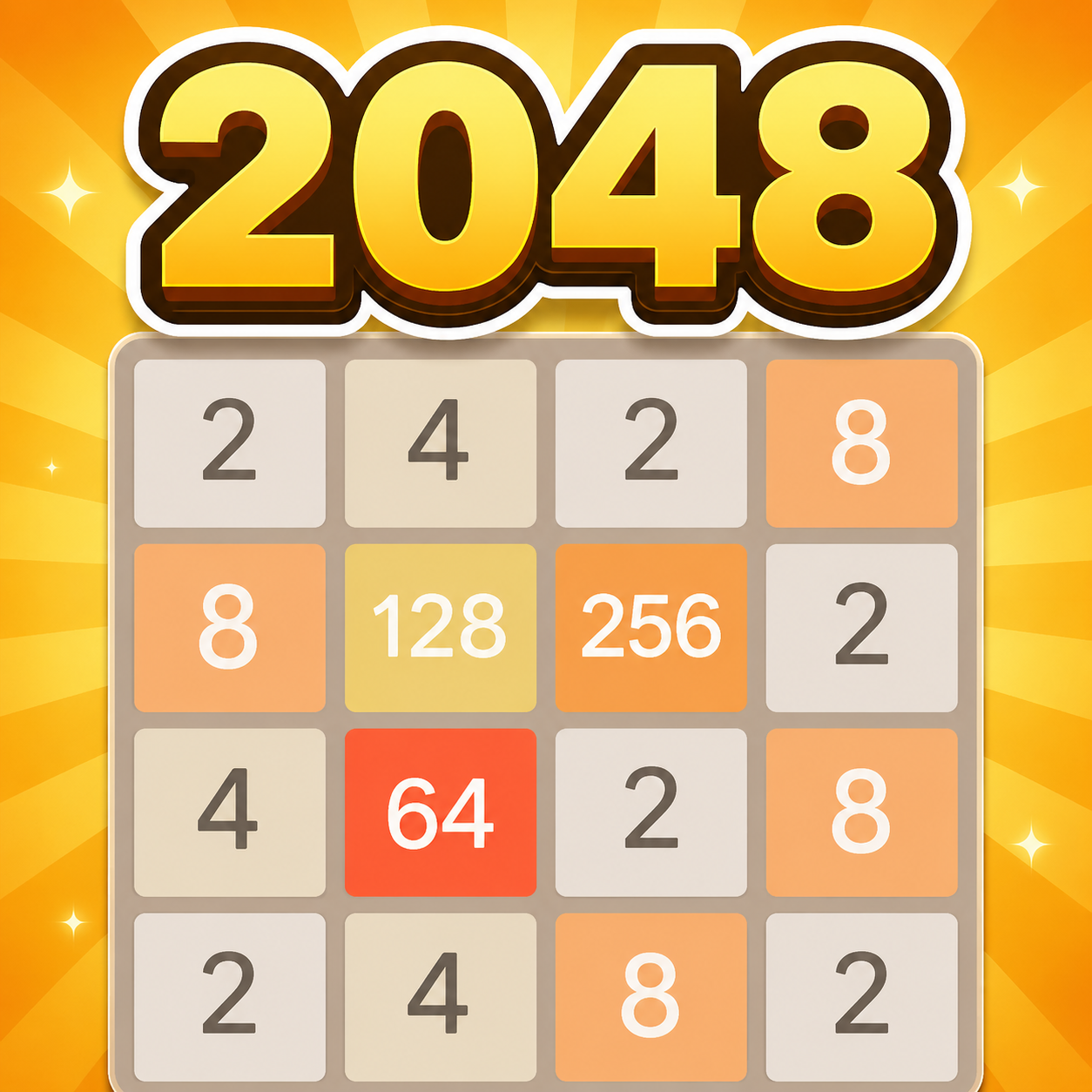
subject: The 2048 Game: A Simple Puzzle with Deep Strategic Thinking [print this page]
Introduction In the modern digital age, games have become an important part of entertainment, education, and everyday life. Among the many puzzle games available on computers and mobile devices, 2048 has earned a special place because of its simple rules, attractive design, and surprisingly challenging gameplay. At first glance, 2048 appears to be an easy mathematical puzzle. The player moves numbered tiles around a small grid and combines tiles with the same value. However, as the game progresses, every move becomes more important, and a single careless decision can make it impossible to continue.
The game was created in 2014 by Italian web developer Gabriele Cirulli. It was inspired by earlier games, particularly Threes!, but its simple mechanics helped it spread rapidly across the internet. Players can access versions of the game on computers and mobile devices, making it convenient and accessible to people of different ages. The main objective is to create a tile with the number 2048 by combining smaller tiles. Although reaching 2048 is the central goal, many experienced players continue beyond it and attempt to achieve even higher numbers.
The popularity of 2048 demonstrates that a game does not need complicated graphics, a large story, or expensive technology to be engaging. Its appeal comes from the combination of mathematics, planning, probability, patience, and problem-solving. It is both entertaining and mentally stimulating.
Basic Rules of 2048 The rules of 2048 are remarkably simple. The game is normally played on a 4 × 4 grid, which contains sixteen spaces. At the beginning, a few numbered tiles appear on the board, usually with values such as 2 or 4. The player can move all the tiles simultaneously in one of four directions: up, down, left, or right.
When two tiles with the same number collide during a move, they merge into one tile with double their value. For example, two tiles marked 2 can combine to create a 4. Two 4 tiles can become 8, two 8 tiles can become 16, and the process continues:
After each successful move, a new tile generally appears in an empty position. Therefore, the board gradually becomes more crowded. The player must continue combining tiles while preserving enough empty space to make future moves possible.
The game ends when there are no empty spaces and no adjacent tiles that can be combined. Thus, simply creating large numbers is not enough. The player must also manage the limited space on the board.
The Mathematical Side of the Game Mathematics is one of the most interesting aspects of 2048. Every tile is a power of two. The sequence begins with 2, 4, 8, 16, and continues upward. This means that the player is repeatedly performing a mathematical operation: doubling.
The target number, 2048, is itself a power of two:
2048 = 2¹¹
This means that creating a 2048 tile requires a chain of combinations beginning with the smallest tiles. The game therefore provides an informal demonstration of exponential growth. Although the rules are easy to understand, the number of required combinations increases rapidly as the target becomes larger.
For example, creating a 128 tile requires many smaller tiles to be combined. Creating a 1024 tile requires an even larger chain of successful combinations. Finally, producing 2048 requires two 1024 tiles. This illustrates how a simple repeated operation can lead to increasingly large results.
The game can also encourage players to think about numerical relationships. Players quickly learn that combining tiles is not simply about finding two equal numbers. They must consider where those numbers are located and whether merging them will create useful opportunities later.